Mines Game: Play Online Free in Demo Mode

«Across our editorial reviews, we always inspect the fine print before looking at potential multipliers. A casino game like Mines may appear simple on the surface, but understanding its underlying mathematics, random number generator mechanics, and jurisdiction-specific regulatory constraints is essential before making any decision.» Claire Bennett, Senior Casino Content Editor (source: editorial brief).

Last updated / reviewed: January 2026 editorial cycle, checked against the Australian/New Zealand Gaming Machine National Standard (Revision 12.1, 2023), the Interactive Gambling Act 2001, and ACMA enforcement reporting. 18+ only. Gambling involves risk.

Provider

Hacksaw Gaming

RTP

98%

Volatility

High

Min bet

$0.20

Max bet

$1,000

Max win

10,000x bet

Mines Game Play Online Free in

Quick Verdict on Mines

Quick FactDetail
Game typeInstant-win / crash-style arcade grid game (not a reel slot)
Standard grid5×5 (25 tiles); some builds also offer 3×3, 7×7 and 9×9
Configurable mines1 to 24 on a 25-tile grid
Theoretical RTP95.00% to 99.00% depending on provider and operator build (Spribe and Hacksaw builds are commonly published at 98.00%)
Maximum multiplierUp to 500,000x in Spribe's published specification; 10,000x in the Hacksaw Gaming build, both truncated by operator win caps (frequently around $10,000 per round)
Bet rangeFrom $0.10 up to $150 (Spribe) or up to $1,000 (Hacksaw), platform dependent
Demo availableYes, virtual credits, no deposit, usually no registration
Fairness modelRNG plus optional Provably Fair verification using SHA-256 hashing
DevicesHTML5 browser play on desktop, iOS and Android; no standalone game APK exists
Volatility controlPlayer-selected: 1 to 3 mines is low variance, 20 to 24 mines is extreme variance

Bottom line: Mines is a transparent, fast, fully player-configurable risk game. The mathematics are simple and verifiable. But there is no winning system. Every round is an independent RNG event, and the house edge never takes a break. Australian readers should read the Legal Status and Risks for Australia section before considering any real-money play.

What This Guide Covers

This is an informational guide, not a promotion. It works through the mechanics of Mines, the legal position for players in Australia, the step-by-step rules of a round, what the free demo actually lets you test, how mine count shapes volatility, how RTP and payout caps interact, and how mobile play differs between a browser and an operator app. A responsible gambling block and a full FAQ close the article. Read the sections you need, skip the rest.

What the Mines Game Is and

What the Mines Game Is and How It Works

Mines is an instant-win casino game built on a 5×5 grid of hidden tiles concealing safe gems or hidden mines, where each consecutive safe reveal increases the round's payout multiplier. Unlike traditional video slots with spinning reels, this arcade-style title gives players direct agency over round parameters, including wager size and the total number of mines hidden on the grid. The format sits in the same family of fast instant products found across online casinos, alongside crash and dice titles. Every safe tile uncovered increases the current cash value, while revealing a mine instantly ends the round and forfeits the active bet.

The scale of the market in which Mines operates is significant. Digital participation is now mainstream rather than niche:

«In 2024, 33.4% of Australian adults gambled online, roughly one in three adults.» Gambling Participation in Australia 2024, Australian National University (2024). https://polis.cass.anu.edu.au/files/docs/2025/6/Gambling_in_Australia_2024_002.pdf

The core gameplay relies on a

The core gameplay relies on a clear trade-off between risk and reward. Players can end the round and bank the accumulated multiplier after a single safe pick, or keep opening tiles to chase a bigger payout. Rounds are extremely short, typically five to thirty seconds, which is precisely why session discipline matters far more here than in slower-paced products. Thirty rounds can disappear in the time it takes to finish a coffee.

[INFOGRAPHIC: Mines playing field layout]

Mines grid structure: closed tiles, a revealed diamond, the live multiplier readout and the cash-out control. Style: minimalist technical diagram. Labels: 5×5 grid, 25 closed tiles, active multiplier indicator, cash-out control button, mine configuration slider. Alt text: mines game grid layout and rules.

  • Purpose: to visualise the basic Mines interface, the position of the controls, tile states and the win-locking sequence.
  • Semantic markup: <figure> + <figcaption>.
Grid, Hidden Tiles and Mines. The

Grid, Hidden Tiles and Mines

The standard Mines game field uses a structured grid of 25 individual tiles. Before the start of each round, a Random Number Generator (RNG), the software component that produces unpredictable outcomes, distributes a user-selected number of hidden mines across those tiles and fills the remaining positions with safe diamond symbols.

While the design visually mirrors classic minesweeper software, the underlying logic is fundamentally different. In classic minesweeper, players solve a logic puzzle by analysing numerical clues to clear the entire board. In gambling versions of Mines, tile locations are purely probabilistic, and success depends on managing exposure to risk rather than solving deduction puzzles. There are no numeric hints, no flagging mechanic and no board to "clear" for score. Only a stake, a multiplier and an exit decision.

«Game outcomes must be statistically independent, uniformly distributed and unpredictable.» Australian/New Zealand Gaming Machine National Standard, Revision 12.1 (2023). https://www.treasury.tas.gov.au/Documents/TLGC%20Tasmanian%20Appendix%20to%20the%20Australian%20and%20New%20Zealand%20Gaming%20Machine%20National%20Standard%20-%201%20July%202023.PDF

In practical terms, that requirement is what guarantees the mine layout is redrawn from scratch every round, and that no pattern of clicks is ever "due" for success.

Grid Variations From 3 3 to

Grid Variations: From 3×3 to 9×9

Although the industry standard is the 5×5 grid of 25 cells, several providers, Hacksaw Gaming in particular, allow the field size itself to be reconfigured. Change the grid and you change the entire probability curve of the round:

  • Mini grid 3×3 (9 cells): extremely high risk density. Each safe reveal delivers a rapid multiplier increment, but the room to manoeuvre is tiny and a single mine setting can dominate the board.
  • Standard 5×5 (25 cells): the workable balance between mathematical expectation and dispersion, and the configuration used in almost all published paytables.
  • Maxi grids 7×7 (49 cells) and 9×9 (81 cells): each individual gem pays less, but the base chance of striking a mine on the opening picks is lower. This supports long reveal sequences and suits conservative, low-variance approaches.

The mathematics is the same in all cases: with n cells and m mines, the probability of a safe pick on step k equals (n − m − k + 1) / (n − k + 1). This is a hypergeometric model, sampling without replacement, so risk climbs with every tile you open inside the same round, regardless of grid size.

Multiplier, Cash Out and Round Risk

Multiplier, Cash Out and Round Risk

The payout multiplier in Mines increases with every safe tile opened, reflecting the declining ratio of safe tiles left on the grid. If a player configures 3 mines on a 25-tile field, the first safe tile offers a modest multiplier increment, whereas uncovering subsequent tiles accelerates the growth curve sharply.

The cash-out option lets players lock in their accumulated cash return at any point before triggering a mine. Payout is always calculated as stake × current multiplier at the moment of cash out. Nothing more complicated than that.

The regulatory basis for round independence is explicit in Australian and New Zealand technical standards:

«Game outcomes must not be determined before the player has made all of their selections in the round.» Australian/New Zealand Gaming Machine National Standard, Revision 12.1 (2023). https://www.treasury.tas.gov.au/Documents/TLGC%20Tasmanian%20Appendix%20to%20the%20Australian%20and%20New%20Zealand%20Gaming%20Machine%20National%20Standard%20-%201%20July%202023.PDF

Because of this, every decision to continue carries a mathematically calculable, and rising, risk of hitting a mine.

How to Play Mines Online: Step-by-Step Rules

To start playing Mines online, a player selects a stake level, sets the preferred number of mines on the grid, opens tiles one at a time, then decides whether to cash out or continue after each safe reveal. The interface gives you clear controls to adjust bet amounts, configure risk parameters and watch the payout multiplier update in real time.

The sequence of actions is identical across desktop and mobile versions, which makes the gameplay predictable even on a first attempt.

Checklist: the sequence of actions in a Mines round

1
Set the bet amount: Choose your stake size using the in-game options within the operator's established table limits (commonly from $0.10).
2
Configure mine count: Select the number of hidden mines (typically between 1 and 24 on a standard 5×5 grid). Some builds also let you switch grid size first.
3
Start the round: Press the start button to lock in your wager and initialise the hidden grid layout.
4
Reveal hidden tiles: Click tiles one by one to uncover diamonds or hidden mines.
5
Monitor multiplier growth: Track the rising cash value and the payout bar above the grid, which usually displays both the current and the next multiplier step.
6
Execute cash out: Lock in your accumulated winnings before hitting a mine, or lose the active bet if a mine is revealed.
Choosing Your Bet and Mine Count

Choosing Your Bet and Mine Count

Configuring your initial bet and mine count sets the volatility and the potential payout scale of the round. Lowering the mine count (choosing 1 or 2 mines, say) leaves 23 or 24 safe tiles on the board: a high probability of early success, but slow multiplier growth.

Conversely, selecting a high mine count, such as 10 to 15 mines, sharply increases the multiplier assigned to each safe tile.

Publicly available paytable summaries for commercial Mines builds indicate that selecting 24 mines on a 25-tile grid yields a starting multiplier in the region of 24.25x to 24.75x for a single safe pick, accompanied by a 96% chance of hitting a mine on that very first tile. These figures are operator-configurable and are not drawn from a regulator-certified document, so treat them as indicative rather than absolute. Always confirm the live paytable inside the game client. The underlying arithmetic is straightforward and self-checking: with 24 mines on 25 tiles, one safe tile remains, giving a 1-in-25 (4%) chance of success, and a roughly 98% RTP configuration converts that into a payout near 24.5x.

Reported minimum stakes also vary between builds and platforms. Some summaries list $0.01, others $0.10 or $0.20, because the lower boundary is set by the operator's currency table, not by the game engine alone.

Revealing Tiles and the Cash-Out Decision

Revealing Tiles and the Cash-Out Decision

During an active round, players choose tiles individually or use auto-pick features where available. Each safe tile uncovered updates the cash-out display, showing the exact monetary return available if the round is closed immediately.

The decision to cash out or proceed means weighing the current multiplier against the probability of hitting a mine on the remaining closed tiles. Because the RNG outcome for each tile is determined independently of previous rounds, prior successful sessions do not improve your odds. And within the current round, each reveal shrinks the pool of safe tiles, so the risk of the next click is always higher than the last. Worth repeating, because plenty of players get that backwards.

Automation and Advanced Round Controls. Modern

Automation and Advanced Round Controls

Modern Mines builds ship with a full set of round-management tools. Understanding them is essential, because automation removes the moment-to-moment emotional brake that manual play provides:
  • Auto-Pick:locks in a fixed pattern of tile selections that is repeated automatically in every round.
  • Auto-Cashout:sets a target multiplier, for example 2.00x. The round closes automatically and books the profit as soon as that coefficient is reached. This is also the single most useful discipline tool in the game, because it fixes the exit point before the emotion of a winning streak arrives.
  • Auto Bet / Autoplay:runs consecutive rounds hands-free at a preset stake, without manual confirmation between rounds.
  • Loss and win limits:stops the autoplay sequence when a defined session loss threshold is reached, or when a single win exceeds a nominated size. Operators typically extend this with daily, weekly and monthly loss limits, session-duration alerts and cool-off periods from 24 hours to 30 days.
  • Turbo Mode:disables tile-flip animation so results resolve instantly. It increases rounds per minute dramatically, which also increases exposure per hour of play, so treat it as a risk-amplifying setting rather than a convenience.
  • Bet amount limits:minimum and maximum wager restrictions per round, configurable in the account dashboard on compliant platforms.

Mines Demo and Free Play: Testing the Game Without Risk

A Mines demo lets players test the mechanics, explore interface options and watch multiplier scaling using virtual credits, with no real funds and no deposit. This free-play version gives you the same grid controls, mine adjustment sliders and auto-play options found in real-money versions.

Testing the mines free build provides a risk-free environment to evaluate how different mine configurations influence cash-out dynamics over a longer session. Demo builds normally load in a browser window within a few seconds, with no personal information, account creation or deposit required.

What You Can Test in the

What You Can Test in the Mines Demo

In the Mines demo, users can inspect the complete set of in-game features without financial commitment. That includes testing auto-play sequences, checking responsiveness on a phone screen, and observing how rapidly multipliers accumulate under various mine settings.
  • Mine configuration mechanics:verify how adjusting the mine count from 1 to 24 alters starting multipliers, and how the paytable bar recalculates.
  • Grid size behaviour:where supported, compare how the same mine count behaves on 3×3, 5×5, 7×7 and 9×9 fields.
  • Auto-play functionality:test automated round limits, fixed tile selection patterns, auto-cashout triggers and loss-stop rules.
  • Interface options:inspect sound settings, round history displays, full-screen mode and cash-out button responsiveness.
  • Turbo mode:measure how much faster a session burns through rounds when animation is switched off.
Demo Versus Real-Money Mines. The core

Demo Versus Real-Money Mines

The core mathematical algorithm and RNG logic in a certified Mines demo match the mines real money version, but the financial implications and psychological conditions differ completely. Demo mode uses virtual credit balances, so wins cannot be withdrawn as real cash and losses carry zero financial consequence. Regulatory descriptions of dual-mode products are consistent on this point: the RNG mechanism is the same in both modes, and only the stake layer, credits versus cash, changes.

Methodology note. In an internal editorial audit conducted for our informational project on iGaming editorial standards, our team compared how operators disclose free-play availability. The review covered a sample of publicly accessible brand configurations and checked whether demo builds mirrored real-money mine distribution and paytable steps. This was a manual, non-certified editorial review rather than a laboratory test: sample composition, dates and scoring criteria are held internally, so the finding should be read as an editorial observation, not a verified statistical result. What the audit did confirm consistently is that practice play removes the emotional friction associated with real-money bankroll swings. And that absence of friction is itself a documented risk factor.

«Participants who played a demonstration mode of roulette subsequently placed significantly larger bets in real play than a control group with no practice.» Practice Makes Poorer: Practice Gambling Modes and Their Effects on Real-Play in Simulated Roulette, experimental study, 80 participants. https://polis.cass.anu.edu.au/files/docs/2025/6/Gambling_in_Australia_2024_002.pdf

In other words, demo mode is not a neutral training ground. Long winning sequences on virtual credits can calibrate expectations upwards, and that miscalibration transfers into larger real-money stakes.

Responsible gambling disclaimer: Demo versions of Mines are strictly educational tools designed to demonstrate game mechanics. Success in free-play mode does not predict or guarantee positive outcomes when playing with real money. Gambling involves genuine financial risk, and real-money stakes should always stay within strict personal limits.

General information disclaimer: This information is general in nature and does not replace advice from a qualified professional. Demo mode does not guarantee comparable results in real-money play.

Mines Strategy: How to Manage Risk in the Game

No strategy or tile selection pattern can overcome the mathematical house edge or predict where hidden mines sit in a fair game. Because each round is generated by a cryptographically secure Random Number Generator, every hidden tile on the grid carries an independent probability of containing a mine, based strictly on the active parameter settings.

«Gaming software must generate random outcomes from an RNG, and the result of a game must not be dependent on previous games.» Tasmanian Gaming Licence Standards, Tasmanian Liquor and Gaming Commission (1 July 2023). https://www.treasury.tas.gov.au/Documents/TLGC%20Tasmanian%20Gaming%20Licence%20Standards%20-%201%20July%202023.PDF

Effective mines strategy therefore refers exclusively to bankroll management: controlling bet size relative to total funds, and setting strict session limits before you begin. Fixed staking, stop-loss rules and capped progressions do not change expected value. They change only the dispersion of your results, which is to say how quickly you can lose the balance.

Mine Count and the Risk and Reward Balance

Adjusting the number of mines is the primary way to customise volatility in Mines. Fewer mines produce low variance, where safe tiles are frequent but multiplier growth is modest. A higher mine count creates high variance, where rounds end quickly in losses most of the time, offset by rare, high-multiplier payouts.

+-------------------+-----------------+-----------------------+--------------------+
| Selected Mines    | Safe Tiles (5x5)| Initial Hit Risk (%)  | 1st Tile Multiplier|
+-------------------+-----------------+-----------------------+--------------------+
| 1 Mine            | 24 tiles        | 4.0%                  | ~1.01x             |
| 3 Mines           | 22 tiles        | 12.0%                 | ~1.09x             |
| 5 Mines           | 20 tiles        | 20.0%                 | ~1.20x             |
| 10 Mines          | 15 tiles        | 40.0%                 | ~1.60x             |
| 15 Mines          | 10 tiles        | 60.0%                 | ~2.40x             |
| 20 Mines          | 5 tiles         | 80.0%                 | ~5.00x             |
| 24 Mines          | 1 tile          | 96.0%                 | ~24.25x            |
+-------------------+-----------------+-----------------------+--------------------+

Provider guidance and community consensus broadly align on the practical bands: 1 to 3 mines for low risk and long, stable sessions; 5 to 10 mines for a balanced profile; and 15 to 24 mines for extreme variance, where a single correct pick can pay several times the stake.

Two Common Mathematical Models of Play

Two Common Mathematical Models of Play

  1. Low-variance model, "grind and bank":
    • Settings: 1 to 3 mines on a 5×5 grid.
    • Tactics: open 2 to 4 tiles per round and exit without exception at multipliers of roughly 1.15x to 1.30x. First-click success probability sits between about 88% and 96%.
    • Profile: frequent small wins, shallow drawdowns, and a slow, steady erosion of balance driven by the house edge rather than by single catastrophic rounds.
  2. High-variance model, "sniper":
    • Settings: 20 to 24 mines on a 5×5 grid.
    • Tactics: set the minimum stake ($0.10) and open exactly one tile. With 20 mines a successful first click returns roughly 5.00x; with 24 mines it returns roughly 24.25x.
    • Profile: built for short bursts and rare large payouts. Expect long losing sequences. At 24 mines, 96 of every 100 opening clicks fail on average.

Neither model beats the house edge. Both simply choose how the same expected loss is spread across time.

Bet Limits and Session Control. Session

Bet Limits and Session Control

Session control starts with pre-commitment boundaries set before the game loads, not after the first loss. Responsible play guidance suggests limiting individual wagers to a small fraction of your overall budget, typically 1% to 2%, so natural variance sequences do not drain funds in minutes. Because a Mines round can resolve in five seconds, and faster still in Turbo mode, an hourly exposure calculation is far more useful than a per-round one. A quick sanity check: 30 rounds per minute at $1 a round is $1,800 of turnover in an hour.

Under the Interactive Gambling Act 2001 (IGA), real-money online casino products are prohibited from targeting players located in Australia (Department of Infrastructure, Transport, Regional Development, Communications and the Arts, 2024). For users researching interactive titles, responsible gaming features such as deposit limits, session timers, loss caps and self-exclusion tools are critical criteria when assessing any gaming brand's compliance posture. The 2023 credit and payment restrictions summarised in the legal block above are a useful compliance signal in their own right.

Legal disclaimer: This information is general in nature and is not a substitute for professional advice. Gambling legislation varies by jurisdiction.

Fact check / algorithmic integrity:

  • Mine placement is random: mines are distributed by an RNG at the start of each round; previous tile reveals do not influence future rounds.
  • No memory effect: the game does not track player history or shift safe tile positions based on recent wins or losses.
  • Provably Fair verification: many modern Mines titles use SHA-256 cryptographic hashing in a commit-then-reveal protocol. The operator publishes a hash of the server seed before the round; after the round the original seed is disclosed, letting the player confirm the layout was fixed in advance and that no round was altered retroactively. The outcome is derived from the committed server seed combined with a client seed and nonce.

RTP, Payout and Win Potential in Mines

Financial information disclaimer: This information is general in nature. RTP, bet limits and payout conditions vary by operator and jurisdiction. Confirm current parameters directly with a licensed operator before wagering.

Return to Player (RTP) in Mines represents the theoretical long-term payout percentage, calculated over millions of game rounds rather than over your session.

«RTP is defined as the ratio of total wins to total turnover over a game cycle, including progressive prizes.» Australian/New Zealand Gaming Machine National Standard, Revision 12.1 (2023). https://www.treasury.tas.gov.au/Documents/TLGC%20Tasmanian%20Appendix%20to%20the%20Australian%20and%20New%20Zealand%20Gaming%20Machine%20National%20Standard%20-%201%20July%202023.PDF

Commercial versions from leading providers publish

Commercial versions from leading providers publish theoretical RTP values in the 95.00% to 99.00% band, with 98.00% the most commonly stated figure for both the Spribe and Hacksaw Gaming builds. Note the source: that range is compiled from provider-facing product documentation and operator lobby disclosures, not from a single independent certification register. Regulator-published minimums differ by jurisdiction, and independent verification of any specific build's RTP requires the operator's own certificate. Where a competing review claims RTP accuracy "tested over 10,000,000,000 simulations", that figure is a marketing formulation with no published eCOGRA or iTech Labs certificate attached. Treat it as unverified.

Maximum win potential is governed by operator caps, table limits and the maximum multiplier boundary set in the software parameters.

Game ParameterStandard SpecificationNote / Context
Theoretical RTP95.00% to 99.00%Varies by provider and operator configuration
Grid Size5×5 (25 tiles) standard; 3×3 / 7×7 / 9×9 in selected buildsGrid size alters per-tile payout and mine density
Configurable Mines1 to 24 minesDirectly alters volatility and starting multipliers
Minimum BetFrom $0.10 / €0.10 / £0.10 (some builds from $0.01 to $0.20)Platform-dependent stake lower boundary
Maximum Bet$150 (Spribe) to $1,000 (Hacksaw)Operator table limits apply
Maximum MultiplierUp to 500,000x (Spribe) / 10,000x (Hacksaw)Theoretical software ceiling
Maximum Cash PayoutFrequently capped around $10,000 AUD per roundOperator win cap, separate from the multiplier ceiling
Round DurationAbout 5 to 30 secondsTurbo mode reduces this further
Platform SupportMobile browser (HTML5), desktop, operator app or PWANative touch scaling across iOS and Android

Provider Comparison: Spribe vs Hacksaw Gaming vs Turbo Games

Game parameters differ substantially depending on which studio built the version you are looking at. Confusing the studios is the most common source of misquoted "max win" figures:

ParameterSpribe MinesHacksaw Gaming MinesTurbo Games Mines
Stated RTP98.00%98.00%95.00%
Bet range$0.10 to $150$0.20 to $1,000Operator-dependent
Max multiplier500,000x (theoretical ceiling; operator cash caps, often $10,000, apply)10,000xOperator-dependent
Grid options5×53×3, 5×5, 7×7, 9×95×5
Mine range1 to 241, 3, 5, 7 presets plus customFixed mine sets in some modes
Notable featuresAuto-cashout, autoplay, live statistics, Provably FairConfigurable grid size, payout bar above grid, full-screen modeTurbo Mode for accelerated rounds
Technology / releaseHTML5, crash-style instant winHTML5, released 2022HTML5

Important correction to a widely repeated figure. Earlier editions of this guide described the maximum win as "up to $10,000+ AUD / 10,000x". That framing conflated two separate limits. The 10,000x figure belongs to the Hacksaw Gaming build; Spribe's published specification lists a theoretical ceiling of 500,000x; and $10,000 AUD is an operator-imposed cash cap on a single round's payout, not a limit on the multiplier itself. In practice the cash cap is the binding constraint for almost every player.

Why RTP and Payout Must Be

Why RTP and Payout Must Be Checked at the Specific Casino

Software developers frequently offer configurable RTP ranges to casino operators. So a single Mines title can run at 97.00% RTP on one platform and 95.00% on another, depending on local regulatory requirements and commercial configuration. Differences also emerge when a platform deploys a different certified build, applies regional restrictions, or changes table limits, mine options or cash-out coefficients. Any of those shifts the effective payout ceiling.

Maximum payout caps enforced by operators can also truncate high-multiplier wins, which is exactly why jurisdictional disclosure rules exist:

«The Tasmanian standard sets a minimum RTP of 87% for gaming machines and requires RTP disclosure for each game type.» Tasmanian Appendix to the Australian and New Zealand Gaming Machine National Standard (1 July 2023). https://www.treasury.tas.gov.au/Documents/TLGC%20Tasmanian%20Appendix%20to%20the%20Australian%20and%20New%20Zealand%20Gaming%20Machine%20National%20Standard%20-%201%20July%202023.PDF

The practical lesson: an advertised RTP on a review site is a starting point, never a guarantee. Open the game's info panel on the platform you are actually using and read the figure there. It takes about ten seconds.

How to Evaluate an Offer Before

How to Evaluate an Offer Before Playing for Real Money

When assessing an operator offer or promotional bonus involving fast arcade titles like Mines, the wagering conditions matter more than the headline number. Many welcome bonuses exclude instant-win games outright or apply reduced game weighting toward the wagering requirement. Readers comparing licensed casino operators should treat the bonus terms page, not the landing page, as the source of truth.

Key criteria to check before registering an account:

  1. Licensing and legal status: confirm whether the brand holds valid regulatory authorisation for your jurisdiction, and remember the IGA position outlined above if you are in Australia.
  2. Game weighting: verify whether Mines wagers count 100% toward bonus wagering or are capped at a lower percentage. Instant-win titles are frequently weighted at 0% to 20%.
  3. Withdrawal limits and verification: inspect minimum withdrawal thresholds, processing times, per-round and per-day win caps, and mandatory KYC rules. Ask how long verification usually takes before you deposit, not after.
  4. Payment options: review the available payment gateways, looking for secure debit support and steering clear of predatory fee structures, credit-based funding or opaque crypto rails.
  5. Responsible gambling tooling: confirm that deposit limits, loss limits, session reminders, cool-off periods and self-exclusion exist, then test that they can actually be set.
  6. Max-win clarity: check whether the operator publishes a per-round payout cap. On a 500,000x-capable title, that single clause defines your realistic ceiling.

Mines Mobile: Playing in a Browser, App or After Download

Mines is built on HTML5, which is why the same build runs across smartphones, tablets and desktops without specialised software. The grid scales automatically to fit different screen sizes and the controls for opening tiles and triggering cash-outs are touch-friendly. Let us be precise about the basis for that claim: HTML5 delivery and responsive scaling are documented in provider product specifications and directly observable in demo builds, but "full optimisation" is not an independently certified property. Performance still depends on device hardware, browser version and connection quality. Reported load times for browser demo builds sit in the five-to-thirty-second band, and round resolution is unaffected by device class on modern handsets.

Players can reach the game directly through a standard mobile browser, or via a dedicated operator application where one exists.

[DIAGRAM: Ways to launch Mines on mobile devices]
+----------------------------------+----------------------------------+
|      Mobile Web Browser (HTML5)  |     Dedicated Mobile App / PWA   |
+----------------------------------+----------------------------------+
| • Instant access via browser     | • Requires download / installation|
| • Zero storage space required    | • Consumes local device storage  |
| • Automatic game updates         | • Manual software update cycles  |
| • Full access to demo & features | • May offer push notifications   |
| • No installation permissions    | • May offer biometric login      |
| • Lower security exposure        | • Higher trust required in source |
+----------------------------------+----------------------------------+

Technical differences between launching Mines in a mobile browser and installing a downloadable application. Alt text: mines mobile browser vs app download comparison.

  • Purpose: to demonstrate the technical differences between browser-based launch and app installation.
  • Semantic markup: <figure> + <figcaption>.

Mines App and Mobile Version

The mines mobile interface reorganises the control panels for vertical touchscreens. Mine configuration sliders, bet adjustment fields, payout bars and cash-out indicators sit within reach for one-handed operation, and visual elements are streamlined so performance holds up on mid-range Android and iOS hardware.

The commercial driver behind mobile-first design is measurable participation data:

«In 2024, 33.4% of Australian adults gambled online, evidencing a long-term shift towards mobile platforms.» Gambling Participation in Australia 2024, Australian National University (2024). https://polis.cass.anu.edu.au/files/docs/2025/6/Gambling_in_Australia_2024_002.pdf

When a Download Is Needed and

When a Download Is Needed and When a Browser Is Enough

For the vast majority of players, launching Mines directly in a modern mobile browser such as Safari or Chrome is the fastest and safest route. Browser play removes any need for a mines download from unverified sources, takes up no storage, and updates itself.

A dedicated app download or Progressive Web App (PWA) installation is generally only worthwhile if an operator provides offline demo practice, biometric login or push notifications you genuinely want. When weighing mobile options, avoiding standalone .apk files from unknown sites is vital for device security and personal data protection.

«The ACMA blocked 56 sites in a single quarter of 2023, many of which used alternative domains to evade blocking.» ACMA, Action on interactive gambling: January to March 2023. https://www.acma.gov.au/publications/2023-05/report/action-interactive-gambling-january-march-2023

That enforcement volume matters for mobile users specifically. Blocked operators routinely resurface on mirror domains, and those mirrors are the main distribution channel for unofficial installers.

🔒 CRITICAL SECURITY WARNING: fake "Mines" APK files

Files circulating online under names such as Mines_Earning_App.apk promise a standalone real-money Mines game. Software providers, including Spribe, Hacksaw Gaming and Turbo Games, do not release standalone APK files for individual games. Their titles are distributed exclusively as HTML5 clients embedded in operator platforms.

Downloading such files from third-party sites exposes your device to malware, credential theft and financial fraud, with no player protection and no recourse.

Safe access route: play Mines only through a mobile browser, or through the official app or PWA published by a licensed casino operator via its own verified domain, the Apple App Store or Google Play. If a site pushes an installer file at you before showing you the game, close the tab.

Responsible Gambling and Support. Mines resolves

Responsible Gambling and Support

Mines resolves rounds in seconds, which compresses hundreds of decisions into a very short session. If any of the following apply, stop and seek support: you are betting more than you planned; you are chasing losses; you are using credit or borrowed money; you are hiding play from others; or play is affecting sleep, work or relationships.

Practical safeguards worth setting before you open the game:

  • A hard session budget and a session clock, both defined in advance.
  • Deposit and loss limits configured in the account dashboard, not in your head.
  • Auto-cashout at a fixed multiplier, so the exit decision is pre-committed.
  • Turbo mode switched off, because speed multiplies exposure, not expected value.
  • A cool-off or self-exclusion period activated at the first sign of loss-chasing.

18+ only (or the legal gambling age in your jurisdiction). Play responsibly. This article is informational and general in nature; it is not financial, legal or medical advice. If gambling is causing you or someone you know harm, contact a licensed gambling support service in your jurisdiction.

FAQ About the Mines Game. Do

FAQ About the Mines Game

Do I need to register to play the Mines demo?

In most cases, no. The majority of Mines demo builds run directly in a browser without an account and without a deposit. Practice mode uses virtual credits, so you can test the interface, the mine slider and multiplier behaviour at no cost. Virtual credits carry no real-world monetary value and cannot be withdrawn.

Can I change the grid size in Mines?

It depends on the provider. The industry standard is a fixed 5×5 grid of 25 tiles, which is what Spribe uses. The Hacksaw Gaming build allows the field to be switched between 3×3, 5×5, 7×7 and 9×9. Larger grids pay less per gem but reduce the chance of striking a mine on the opening picks; smaller grids do the opposite.

How does the auto-cashout function work?

Auto-cashout lets you nominate a target multiplier before the round begins, for example 2.00x. As soon as your accumulated multiplier reaches that threshold, the round closes automatically and the win is credited. It is normally combined with Auto-Pick (a fixed click pattern) and autoplay, plus session loss and win limits that halt the sequence at a defined boundary. Used properly, auto-cashout is the most effective discipline tool in the game, because it fixes your exit point while you are still calm.

Is there a standalone official app for the Mines game only?

No. Developers such as Spribe, Hacksaw Gaming and Turbo Games do not publish standalone mobile applications for a single title. Mines is integrated into the web platforms of licensed operators or delivered as an HTML5 build in the browser. Any file advertised as a dedicated "Mines earning app" APK should be treated as untrusted.

What is the maximum win in Mines?

The theoretical software ceiling differs by studio: Spribe's specification lists up to 500,000x, while the Hacksaw Gaming build lists 10,000x. In practice, the binding constraint is the operator's cash cap on a single round's payout, frequently around $10,000. Always check the operator's terms for its maximum payout clause, because it can truncate an extreme multiplier win.

How do I verify the fairness of Mines results?

Many modern Mines versions use a Provably Fair system based on SHA-256 cryptographic hashing. Before the round, the operator publishes a hash of the server seed. After the round, the original seed is revealed, and you can re-hash it in the settings menu to confirm the mine layout was locked in before your first click. Combined with the client seed and nonce, this proves no individual round was altered after the fact.

Can a strategy guarantee a win in Mines?

No. No strategy or tile-opening pattern can guarantee a win. Mine placement is determined by a random number generator, each round is independent of the previous one, and the house edge is permanent. Strategy in Mines is limited to controlling stake size, choosing your volatility level via the mine count, and enforcing session limits.

What is the best number of mines for a beginner?

Three to five mines on a 5×5 grid is the usual starting point. It leaves 20 to 22 safe tiles, so reveals feel frequent enough to observe how the multiplier builds, while variance stays modest. Once the rhythm is familiar, higher mine counts can be tested, ideally in demo mode first and always at minimum stake.

Is Mines legal to play for real money in Australia?

Under the Interactive Gambling Act 2001, providing or advertising real-money online casino games to consumers located in Australia is prohibited. The offence applies to operators rather than individual players, but any site offering real-money Mines to an Australian resident is operating outside the Australian licensing framework, with no local regulator overseeing payouts or disputes. The ACMA actively blocks such sites. Free demo play remains the risk-free option.

Do I need to download anything to play on mobile?

No. The HTML5 build runs entirely in a mobile browser, with the grid, mine slider and bet controls scaling automatically to the screen. An operator app or PWA is optional and only worth installing from an official store or the operator's verified domain. Never install a .apk file sourced from a third-party site.

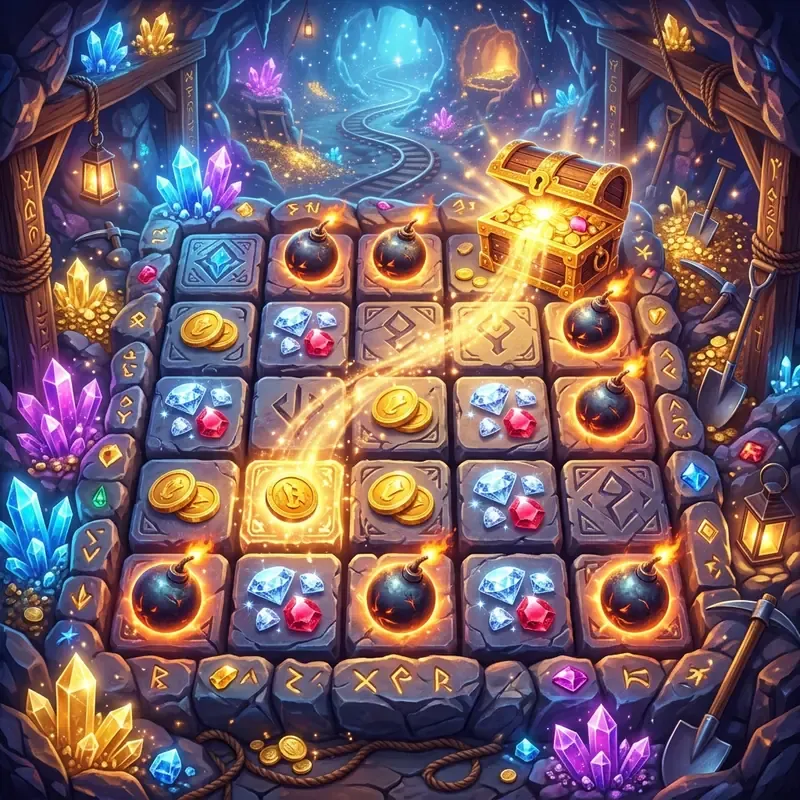
Appendix A Editorial Revision Notes. For

Appendix A: Editorial Revision Notes

For transparency, the following statements appeared in earlier editions of this guide and have been superseded in the main text above:
  • Maximum payout:previously "Up to $10,000+ AUD / 10,000x". Superseded, because the multiplier ceiling and the operator cash cap are separate limits, and the 500,000x Spribe specification was not reflected.
  • Round independence citation:previously "(ANZ Gaming Machine National Standard, 2023)" without a verifiable URL or quotation. Superseded by the quoted Revision 12.1 clause with a direct link.
  • RTP disclosure citation:previously "(Tasmanian Gaming Licence Standards, 2023)" without figures or a URL. Superseded by the quoted 87% minimum-RTP and disclosure requirement with a direct link.
  • Mobile participation citation:previously "(ANU Gambling Participation Report, 2024)" without a URL. Superseded by the quoted 33.4% figure with a direct link.
  • Editorial audit claim:previously "(iGaming Review Standards, 2026)" presented in an academic citation format, alongside "we reviewed 14 online brand configurations" without stated methodology. Superseded by an explicit editorial-review note describing the limits of that observation.
  • Bet-range and multiplier figures attributed to Galaxy of Slots: retained as indicative paytable data, reframed as operator-configurable and non-certified, with the arithmetic shown so readers can verify it themselves.